Palmitoylethanolamide (PEA) is a fatty acid amide your body produces naturally in response to cellular stress. As a supplement, it has attracted genuine scientific interest for its role in modulating pain signaling and neuroinflammation, primarily through activation of the PPAR-α nuclear receptor and stabilization of mast cells: neither of which involves opioid pathways. That mechanistic profile has driven a surge of consumer interest, and with it a crowded, inconsistent supplement market.
Not all PEA products are equivalent. The raw material is a waxy, poorly water-soluble crystal, and how a manufacturer handles that chemistry has a direct bearing on how much of the compound your body actually absorbs. Understanding a few technical terms (particle size, micronization, certificates of analysis) can help you cut through marketing language and make a more informed purchase.
Key Takeaways
- Particle size matters: micronized and ultra-micronized PEA are the forms used in most clinical research, though no head-to-head trial compares them with unmicronized PEA [5].
- Always request a lot-specific COA from an ISO 17025-accredited laboratory before purchasing; verify potency, heavy metals, and microbial panels.
- Clinical studies have generally used 300 to 1,200 mg of PEA per day; products dosed well below this range cannot be directly compared to existing evidence.
- Disease treatment claims (‘eliminates pain,’ ‘repairs nerves’) are regulatory violations and a reliable signal of a company willing to mislead buyers.
- If you take prescription medications (especially immunosuppressants, anticoagulants, or chemotherapy) consult a physician before starting PEA.
Why Particle Size Is Not a Marketing Gimmick
PEA is poorly soluble in water, but a pharmacology review found no published information on its oral bioavailability or how it varies between people [6]. To address this, manufacturers apply mechanical milling processes that reduce particle diameter from hundreds of micrometers down to the single-digit micrometer range. The resulting material is called micronized PEA (m-PEA); a further reduction produces ultra-micronized PEA (um-PEA); a review reports 2 to 6 micrometres for micronized and 0.8 to 2 micrometres for ultramicronized PEA [7].
Smaller particles have more surface area relative to their mass, but a pharmacology review found no head-to-head trial of micronized versus unmicronized PEA and little data on actual absorption [5][6]. The majority of published clinical research on PEA has used either micronized or ultra-micronized formulations[2]. If a product label simply says ‘palmitoylethanolamide’ with no particle-size disclosure, there is a reasonable chance you are buying standard crystalline material whose absorption may be substantially lower than what was studied in clinical settings.
When evaluating a product, look for explicit language such as ‘micronized,’ ‘ultra-micronized,’ or specific trade names associated with pharmaceutical-grade milling. Be skeptical of vague terms like ‘bioavailable PEA’ or ‘optimized formula’ without further technical detail.
Third-Party Testing: What to Look For and How to Read a COA
A certificate of analysis (COA) is a document generated by an independent laboratory confirming that a product contains what its label claims and is free from specified contaminants. Requesting or downloading a COA is the single most useful step a buyer can take before purchasing any dietary supplement, including PEA. The COA should be product-specific, tied to the lot number you are buying, not a generic document issued years ago for a different batch.
Research note: A placebo-controlled trial in people with low to moderate carpal tunnel syndrome found PEA 600 mg/day did not improve clinical or electrophysiological measures [14].
Reputable COAs are issued by ISO 17025-accredited laboratories, which means the lab’s testing methods have been independently audited for accuracy and consistency. Check that the COA reports actual PEA content in milligrams or as a percentage of label claim, with acceptable variance typically within plus or minus 10 percent. Beyond identity and potency, a thorough COA will screen for heavy metals (lead, arsenic, cadmium, mercury), microbial contamination, residual solvents, and pesticides. Absence of these panels is a meaningful red flag.
Some manufacturers post COAs on their websites; others provide them only upon request. A company that cannot or will not share a current, lot-specific COA is not a company worth buying from, regardless of how compelling the marketing copy is.
Understanding Formulation Choices: Plain PEA, Combinations, and Delivery Systems
PEA supplements come in several formulation strategies beyond simple micronization. One common approach is co-formulation with luteolin, a flavonoid with its own anti-neuroinflammatory properties. The rationale is that luteolin may act synergistically with PEA by supporting the same mast cell and glial pathways, though the two compounds have distinct mechanisms. Look for transparent labeling of both ingredients and their individual doses rather than a proprietary blend that obscures amounts.
Sustained-release or enteric-coated capsules are marketed to improve tolerability and extend the absorption window. These can be legitimate engineering choices, but they make third-party verification of dissolution behavior more complex. If you choose a modified-release product, prioritize manufacturers who provide dissolution data alongside standard potency testing.
Powder-filled capsules and tablets are both acceptable delivery forms; what matters more than the physical format is the quality of the raw material and the rigor of quality control. Softgels are less common for PEA because the compound is a solid at room temperature, so a softgel claiming to contain liquid PEA warrants scrutiny about what carrier oil is being used and whether it affects stability.
Dosage: What the Research Has Actually Used
Clinical studies have generally used total daily doses ranging from 300 mg to 1,200 mg of PEA, most commonly split into two or three administrations per day[2][3][4]. The majority of trials lasting four to eight weeks used doses in the 600 mg to 900 mg range. Lower-dose products, some marketed at 100 mg to 200 mg per capsule with no guidance to take multiple capsules, may fall meaningfully below the amounts studied, which limits your ability to draw comparisons to existing evidence.
This does not mean higher is always better or that you should self-escalate without reason. It means that when you evaluate a product, you should be able to map the labeled dose to what has been used in clinical research. If a manufacturer cannot or will not answer that question clearly, that is informative.
Red Flags That Should Give You Pause
Disease claims are the most direct red flag. No dietary supplement, including PEA, is FDA-approved to diagnose, treat, cure, or prevent any disease. Language such as ‘clinically proven to eliminate chronic pain,’ ‘repairs nerve damage,’ or ‘replaces prescription medication’ is not only legally problematic, it signals a company willing to mislead buyers on fundamental regulatory facts. PEA has a genuine and growing body of research behind it; it does not need false claims to be interesting.


Proprietary blends that list PEA alongside other ingredients under a single combined milligram total prevent you from knowing whether you are getting a meaningful dose of any individual component. This practice is common in the supplement industry and is rarely in the consumer’s interest. Similarly, products that omit particle size information, cannot produce a COA, or reference clinical studies without accurately characterizing what those studies actually found deserve skepticism.
Extremely low prices can indicate cutting corners on raw material quality, third-party testing, or both. Pharmaceutical-grade micronized PEA is not cheap to produce, and a 90-capsule bottle priced at four dollars almost certainly does not reflect genuine manufacturing investment. Price alone is not a quality signal, but dramatic under-pricing relative to comparable products is worth investigating before purchasing.
Practical Steps Before You Buy
Start by verifying the particle size disclosure on the label or product page. If it says micronized or ultra-micronized and names a recognizable milling standard or trade ingredient, that is a positive signal. Next, locate or request a lot-specific COA from an ISO 17025-accredited laboratory and confirm that it covers identity, potency, heavy metals, and microbial testing.
Check that the daily dose aligns with the 300 mg to 1,200 mg range documented in clinical research. Scan the product page and marketing materials for disease treatment claims; their presence is a disqualifying signal. Finally, research the manufacturer’s history, country of origin for the raw material, and whether the facility holds any relevant certifications such as NSF for Sport or USP verification, which add an additional layer of third-party oversight.
If you are currently taking immunosuppressants, anticoagulants, chemotherapy agents, or other prescription medications, consult a physician before adding PEA to your routine. While PEA has demonstrated a favorable tolerability profile in clinical trials, interactions with these drug classes have not been systematically studied and professional guidance is warranted.
🛒 Where to Buy Palmitoylethanolamide (PEA)
- Wellness Resources PEA Ultra with Levagen+
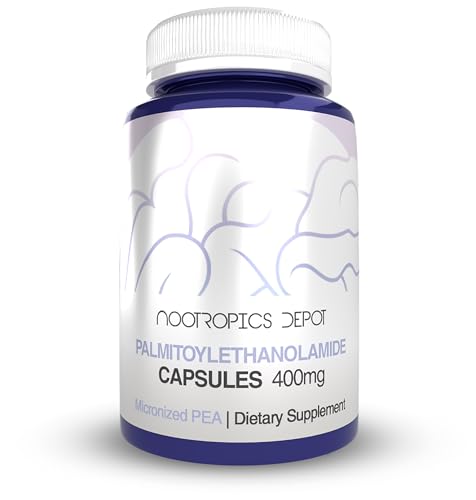
capsules, 300 mg PEA (as Levagen+) per serving: Levagen+ with LipiSperse, a branded PEA ingredient marketed for solubility and absorption - Nootropics Depot Palmitoylethanolamide (PEA) Capsules
capsules, 400 mg micronized PEA per capsule: two or three capsules reach the 600 to 1,200 mg daily range used in trials - Liftmode Palmitoylethanolamide (PEA) Powder
powder, 400 mg per measured scoop: Powder form allows flexible dosing and is significantly cheaper per gram for long-term daily users
As an Amazon Associate we earn from qualifying purchases. PEA quality depends on particle size more than price. Most clinical research used micronized or ultramicronized material, so prefer a product that states its particle size grade or names a branded ingredient such as Levagen+, and check the daily serving reaches the 600 to 1,200 mg used in trials. A label reading only palmitoylethanolamide, with no particle size disclosure, may be standard crystalline powder, but no published human data show how much any PEA form is absorbed [6].
A Note on the Evidence
The clinical evidence for PEA, while promising and growing, largely consists of trials that are small or short in duration; larger, long-term studies are still needed to firmly establish efficacy and safety across diverse populations. This article is informational only and does not constitute medical advice: individuals with chronic conditions or those taking prescription medications should speak with a qualified healthcare provider before using any PEA supplement.
Pooled analyses of PEA for pain favour PEA over controls, but they combine few and varied trials of often poor quality, and one found that neither dose nor treatment duration changed the measured benefit [13].

Frequently Asked Questions
What is the difference between micronized and ultra-micronized PEA?
Both refer to PEA that has been mechanically milled to reduce particle diameter, which increases surface area and improves dissolution in the gut. Ultra-micronized PEA has smaller particles than standard micronized PEA; a review reports 0.8 to 2 micrometres versus 2 to 6 micrometres [7]. Most published clinical trials have used one of these two forms rather than unprocessed crystalline PEA.
How does PEA work in the body?
PEA acts primarily as an endogenous ligand for the PPAR-α nuclear receptor, a transcription factor involved in regulating inflammatory gene expression[1]. Effects on mast cells and microglia are mostly shown in animal and cell studies rather than in people [8][9]. Importantly, this mechanism does not involve opioid receptors, which distinguishes PEA from analgesic drugs that carry dependence risks.
Is a COA from the manufacturer's own lab acceptable?
In-house testing creates an obvious conflict of interest and is generally not sufficient on its own. A credible COA should come from an independent, ISO 17025-accredited laboratory with no financial relationship to the manufacturer. The document should be tied to the specific lot number of the product you are purchasing, not a historical batch.
Can I take PEA with other supplements or medications?
PEA has a generally favorable safety profile in clinical trials, and it is commonly taken alongside other supplements without reported issues in healthy adults. However, its interactions with prescription drugs (particularly immunosuppressants, anticoagulants, and chemotherapy agents) have not been well characterized in systematic research. Anyone on these medications should consult a prescribing physician before adding PEA.
How long does it typically take to notice effects from PEA?
Clinical trials have generally run for four to twelve weeks, and many participants in these studies reported gradual changes over that timeframe rather than immediate effects. PEA is not a fast-acting analgesic in the way that over-the-counter pain relievers are; its proposed mechanism involves modulating inflammatory tone over time. Expecting rapid symptom relief within hours of a first dose is inconsistent with how this compound is thought to work.
Are there any known side effects of PEA?
PEA is an endogenous compound, your body makes it naturally, and pooled analyses of mostly open-label trials report few adverse events, and most human studies were short and designed to test efficacy rather than safety [10][11][12]. Mild gastrointestinal symptoms have been noted in some participants. This favorable tolerability record applies to study populations; it does not guarantee individual tolerance, and it should not be extrapolated to populations taking certain prescription drugs without medical guidance.
References
- Di Stefano V et al. Palmitoylethanolamide: A Multifunctional Molecule for Neuroprotection, Chronic Pain, and Immune Modulation. Biomedicines (2025). PMID 40563990
- Bortoletto R et al. Palmitoylethanolamide supplementation for human health: A state-of-the-art systematic review of Randomized Controlled Trials in patient populations. Brain, behavior, & immunity – health (2025). PMID 39839988
- Salaffi F et al. Palmitoylethanolamide and acetyl-L-carnitine act synergistically with duloxetine and pregabalin in fibromyalgia: results of a randomised controlled study. Clinical and experimental rheumatology (2023). PMID 37378482
- Rao A et al. Palmitoylethanolamide (Levagen+) for acute menstrual pain: a randomized, crossover, double-blind, placebo-controlled trial. Women & health (2025). PMID 39910730
- Linda Rankin et al. Palmitoylethanolamide for the treatment of pain: pharmacokinetics, safety and efficacy. British Journal of Clinical Pharmacology (2016). PMID 27220803
- Rankin L et al. The Basal Pharmacology of Palmitoylethanolamide. International journal of molecular sciences (2020). PMID 33114698
- Roncati L et al. Micronized / ultramicronized palmitoylethanolamide (PEA) as natural neuroprotector against COVID-19 inflammation. Prostaglandins & other lipid mediators (2021). PMID 33636368
- Lorenzo Di Cesare Mannelli et al. Palmitoylethanolamide Is a Disease-Modifying Agent in Peripheral Neuropathy: Pain Relief and Neuroprotection Share a PPAR-Alpha-Mediated Mechanism. Mediators of Inflammation (2013). PMID 23533304
- Francesca Borrelli et al. Palmitoylethanolamide, a naturally occurring lipid, is an orally effective intestinal anti‐inflammatory agent. British Journal of Pharmacology (2014). PMID 25205418
- Giustino Varrassi Palmitoylethanolamide, a Special Food for Medical Purposes, in the Treatment of Chronic Pain: A Pooled Data Meta-analysis. Pain Physician (2016). PMID 26815246
- Earle R. Nestmann Safety of micronized palmitoylethanolamide (microPEA): lack of toxicity and genotoxic potential. Food Science & Nutrition (2016). PMID 28265364
- Wang Y et al. Palmitoylethanolamide in the Treatment of Pain and Its Clinical Application Prospects. Drug design, development and therapy (2025). PMID 40827226
- Artukoglu BB et al. Efficacy of Palmitoylethanolamide for Pain: A Meta-Analysis. Pain physician (2017). PMID 28727699
- Faig-Martí J et al. Use of palmitoylethanolamide in carpal tunnel syndrome: a prospective randomized study. Journal of orthopaedics and traumatology : official journal of the Italian Society of Orthopaedics and Traumatology (2017). PMID 28299455
These statements have not been evaluated by the Food and Drug Administration. This information is not intended to diagnose, treat, cure, or prevent any disease. Content is for informational purposes only and is not medical advice; consult a qualified healthcare provider before starting any supplement. As an Amazon Associate we earn from qualifying purchases.